Header image
House of Pacific Relations
International Cottages, Inc.
  HOME ::
   
 
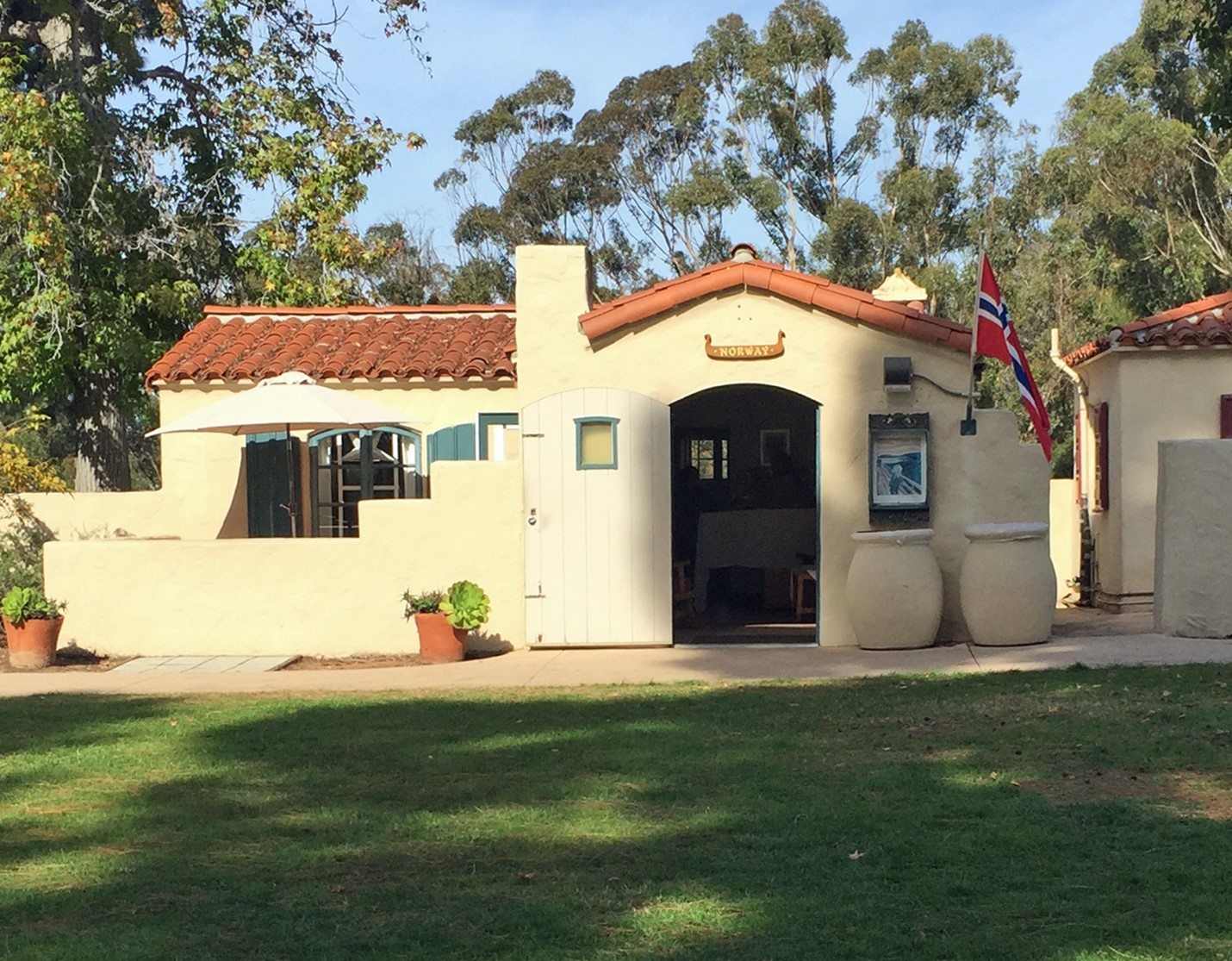
House of Norway
Founded: 1935
Website


large product photo

House of Norway - inside

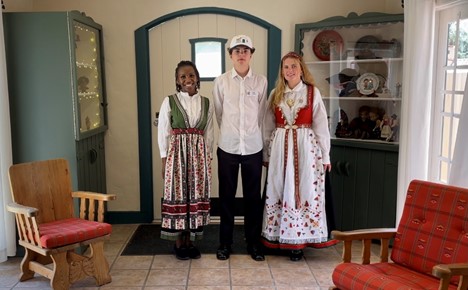
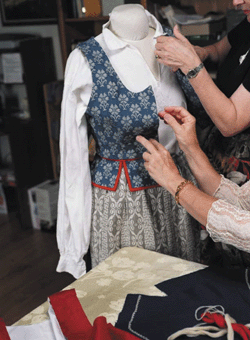
Bunads - Traditional Norwegian Costume

  CULTURAL PROGRAMS

Cooking and Craft Classes:
Every Tuesday from 12:30 – 2:00 pm the members of the House of Norway meet in their cottage for a cooking and baking class as well as a craft class.  They enjoy preparing recipes for any season of the year.  In October the emphasis is on the traditional Christmas specialties, in the spring it is for Easter, and there is something for any time of the year.

The craft class teaches knitting and embroidery, and for Christmas they make Advent decorations.

Bunad Class:
A” Bunad” is a traditional folklore costume in Norway.  Each region of the country has their own specialty costume.  It is worn by women as well as men.

Several times during the year, instructors from Norway come to The House of Norway to teach the members how to make these beautiful costumes.  The times and dates are announced in advance.

Language Class:
A Language Class is taught once a month on Sundays or Tuesdays in the House of Norway from 4:30 – 5:30 pm.  Adults and children participate, it is mostly conversational, but they incorporate music and songs into it to make it more fun for the children.

Rosemaling Class:
About twice a year a Rosemaling class is offered.  This is a very delicate form of painting, where different rose patterns are painted on wood objects like bowls, trays or napkin holders, as well as on doors and furniture.  The House of Norway is fortunate to have a teacher who comes from Norway to teach these classes.  Her name is Lene, she has been Rosemaling for 30 years, first as a hobby and now she has her own workshop in Vennesla.  If you are interested to see some Rosemaling done by Lene, visit the House of Norway, she painted the door at the cottage.


large product photo

Lawn Program during Norway's Centennial

Lawn Program during Norway's Centennial


  CULTURAL EVENTS

Lawn Program:
The yearly lawn program is always held on May 17th, or the Sunday closest to that date.  It is the Norwegian Constitution day, and commemorates the liberation from Denmark in 1814.

The Entertainment is provided by different folk dance groups every year.  The Balboa Park dancers or a group from Los Angeles or a song group from Escondido are performing authentic Scandinavian dances and songs. The” San Diego Mannskor”  (a male choir) delights the audience with Norwegian songs.

Food:
The food fare for the lawn program is the popular Rommegrot ( a sour cream porridge) Lefse, (potato pancake with sugar and cinnamon), Vafler (waffles), Solbaersaft (black currant juice) and coffee.  Ice cream and hot dogs are free for the children.

For the Ethnic Food Fair the menu is the same as it is for the lawn program, without the ice cream and hot dogs for the children.

For the December Holiday you will be able to enjoy the famous Viking Soup with French bread, Lefse, Vafler and hot Solbaertoddy.

Christmas Party:
“Juletrefest” means Christmas Party in Norwegian.  It takes place the first Sunday in January. Christmas in Norway lasts for 20 days, from December 24th to January 13th.

There will be singing and dancing and games for the children.  The Admiral Baker Club House in San Diego is the venue for this event. Here are some holiday song sheets: (right-click to download)

I am so happy on Christmas Eve
A Christmas Dream
I sing a Christmas hymn
Light the Candles

Nordic Nights:
In the summer, usually in June or July a Midsummer Night Festival is planned. It is a shared event with the other Scandinavian Houses and takes place in the Balboa Park Club.

A Nordic Nights Festival is held August in the lawn area of the cottages.

Norsk Fest:
This is a festive evening for and by the friends of Norway. It is to honor the Viking explorer “Leif Erikson”. October 9th is the official “Erikson Day”.  History states that he discovered America in 1003 AD, nearly 500 years before Columbus.   For this gala evening it is suggested to wear the Bunads, and dining and dancing make this a special event.  It is held in one of San Diego’s Hotels.


Queen of the House of Norway   CHILDREN'S PROGRAMS

Barnas Norsk Klubb - What is it?
Do you wish you had more opportunities to teach your children or grandchildren more about their heritage? Do you wish they could learn some Norwegian? Well, your wishes are about to come true. A new club, Barnas Norsk Klubb (The Childrens’ Norwegian Club) has been established at the Norway Hall in Vista. 1ST Sunday of each month, 1PM to 4PM. Click on above link for more details to join.

Fun and educational activities are on the calendar, and the first event was held on February 6th. The format of most events will be:

  • Arts and Crafts on the topic of the month
  • Simple Norwegian language lesson
  • Opportunity for kids and parents to share something about their heritage and the area of Norway their families are from
  • Norwegian Rice Porridge (Risengrynsgrøt) a la Randi, waffles or other staples of Norway
  • Practice a Norwegian Song to be performed at a future event

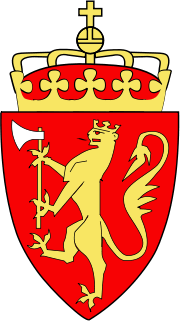
Norway - Coat of Arms

  HISTORICAL NOTES

The emergence of Norway as an independent nation has followed a long process of historical development. Although Norway was unified as a kingdom in the Viking period, it lost its independent status due to dynastic rivalry, disease, and economic decline, coming under the rule of Danish monarchs during the late Middle Ages. This continued until 1814, when the movement for independence first asserted itself at the conclusion of the Napoleonic Wars. A representative assembly drew up a constitution, established a government, and briefly proclaimed a separate state. However, the great powers of Europe had decided that Norway should be joined with Sweden. After a brief conflict, followed by negotiations, a compromise agreement was worked out whereby Norway recognized the king of Sweden as its sovereign, but in turn received a considerable amount of self-rule in the union which followed.

Read further "A Synopsis of Norwegian History" by Oddvar K. Hoidal as Norway's history is reviewed into the 20st century.


Lawn Program during Norway's Centennial   FUTURE PLANS

Continue to present Norwegian culture to visitors entering the House
as well as remaining a gathering point for Norwegian-American
organizations and persons with Norwegian affiliation.


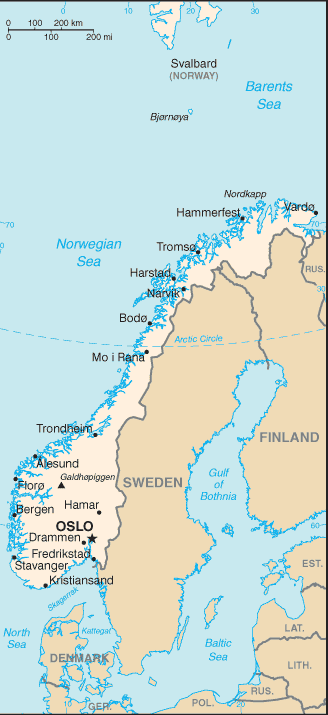
Norway   COUNTRY INFORMATION

Land Area: 323,802 sq km                               
Population:  4,627,926 (July 2007 est.)
Capital City: Oslo                                        
Language:  Bokmal Norwegian (official), Nynorsk Norwegian (official), small Sami- and Finnish-speaking minorities; note - Sami is official in six municipalities
Religion:  Church of Norway 85.7%, Pentecostal 1%, Roman Catholic 1%, other Christian 2.4%, Muslim 1.8%, other 8.1% (2004)
Form of Government: constitutional monarchy
Economy:The Norwegian economy is a prosperous bastion of welfare capitalism, featuring a combination of free market activity and government intervention. The government controls key areas, such as the vital petroleum sector, through large-scale state enterprises. The country is richly endowed with natural resources - petroleum, hydropower, fish, forests, and minerals - and is highly dependent on its oil production and international oil prices, with oil and gas accounting for one-third of exports.
Export: petroleum and petroleum products, machinery and equipment, metals, chemicals, ships, fish


Source: The World Factbook - Norway


Norway


Return to: Countries


Previous Country: Mexico

Next Country: Palestine


IMPORTANT DATES

Lawn Program - Sunday,
May 18, 2008

Visit House of Norway
website for details.


  ©Copyright 2007-08, House of Pacific Relations International Cottages, Inc. All rights reserved.