
|
CULTURAL PROGRAMS |
|
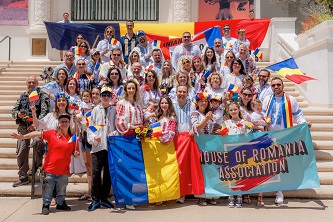
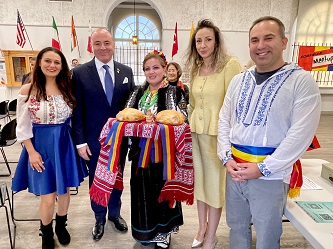
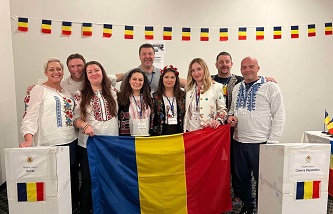
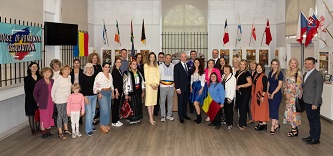
The House of Romania is one of our newest houses at the House of Pacific Relations International Cottages here in Balboa Park. Our organization is dedicated to preserving and fostering Romanian culture, folklore, art, music, history, language and traditions. Through various social and artistic events, the House of Romania will display, nurture, promote and share our culture with the community at large. The House of Romania has monthly meetings where its members discuss general business, set committee goals and answer questions for the general membership. Hall of Nations Sunday Hosting: |
||
|
CULTURAL EVENTS |
|
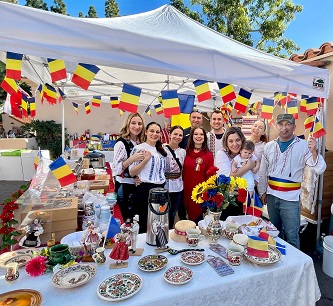
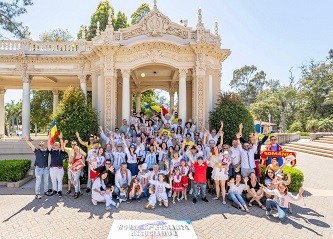
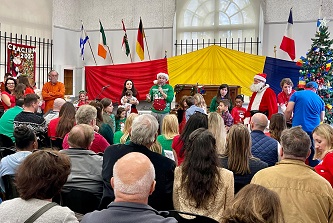
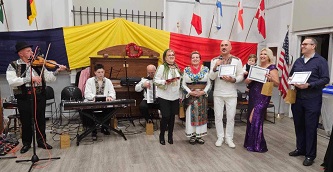
Lawn Program: The annual Lawn Program of the House of Romania is held every year on a Saturday or a Sunday. (See schedule for specific date). The entertainment is provided by different folk music and dance groups every year, performing in regional traditional costumes and depicting Romanian heritage art and culture. International/Ethnic Food Fair: held on the last Saturday of May. House of Romania features traditional foods in a separate booth, on the main lawn. December Nights / International Christmas Festival: held on the first Friday and Saturday of December. House of Romania features traditional foods either in a separate booth, spirits in the Spirit Garden, and/or entertainment on the stage.
|
||
|
CHILDREN'S PROGRAMS |
|
We are in the early stages of setting up a Romanian School, bringing pre-school and school age children together, in an interactive educational program. The various activities are designed to teach Romanian language, history and traditional folkloric dance, and enrich the understanding of Romanian culture. |
||
|
HISTORICAL NOTES |
|
Remains of 34,950-year-old modern humans were discovered in present-day Romania when the Peștera cu Oase was uncovered in 2002. The Romanian fossils are among the oldest remains of Homo sapiens in Europe. Around the 2nd century BC, the kingdom of Dacia was flourishing in the area where modern Romania currently exists. King Burebista ruled Dacian tribes between 82 BC and 44 BC. He established the capital of Sarmizegetusa Regia as the Dacian capital, which reached its zenith as a mighty fortress under King Decebal. In AD 102, Dacia was invaded by the Roman Emperor Trajan. The conquerors established Roman Dacia, as an imperial province. The mixed Daco–Roman population became the ancestors of modern Romanians. The Romanian language emerged as close to the original Latin. After the fall of the Roman Empire, many nomadic tribes invaded and briefly controlled the area during the Middle Ages. The principalities of Moldavia, Wallachia, and Transylvania valiantly fought against the Ottoman Empire, but by 1541 came under Ottoman suzerainty. Later on, the Austro-Hungarian ruled Transylvania, although the Romanians formed the majority of the population in the area. The principalities of Wallachia and Moldavia were formally united in 1862 under the new name of Romania. The country joined the Allied Powers in World War I and subsequently acquired new territories, most notably Transylvania. In 1940, Romania allied with the Axis powers and participated in the 1941 German invasion of the USSR. Three years later, overrun by the Soviets, Romania signed an armistice. The post-war Soviet occupation led to the formation of a communist "people's republic" in 1947 and the abdication of the king. The decades-long rule of dictator Nicolae Ceausescu, who took power in 1965, and his Securitate police state became increasingly oppressive and draconian through the 1980s. Ceausescu was overthrown and executed in late 1989. Former communists dominated the government until 1996 when they were swept from power. Romania joined NATO in 2004, the EU in 2007, and the Schengen Area for air and sea travel in 2024. |
||
|
FUTURE PLANS | |
The House of Romania is continually working with various community groups to develop educational and cultural programs to showcase Romanian traditions and history through music, dance and displays. Soon to be housed in our own “cottage” which will serve as a meeting place, the House of Romania will help foster better understanding of Romanian culture, and it will help strengthen social bonds between nations. |
||
 |
COUNTRY INFORMATION |
|
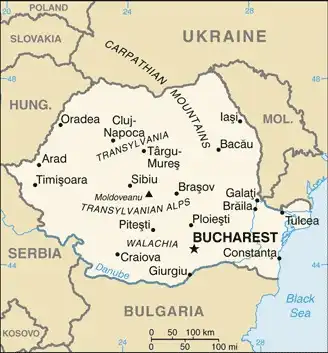
Land Area: 238,391 sq km Source: The World Factbook - Romania |
||